
Bank Holiday Entitlement and Holiday Pay Explained: A Simple Guide Employers
Posted on April 8, 2026
Bank Holidays sound simple on the surface. People assume it means a day off, maybe even extra pay. But from an employer’s point of view, they can raise a lot of questions and, if handled poorly, a fair bit of frustration from staff too.
If you’ve ever had someone say “why do they get it off and I don’t?” you’ll know exactly what we mean.
Here’s a straightforward guide to help you stay on the right side of the rules and avoid those awkward conversations.
Are Employees Entitled to Bank Holidays?
Let’s start with the big one.
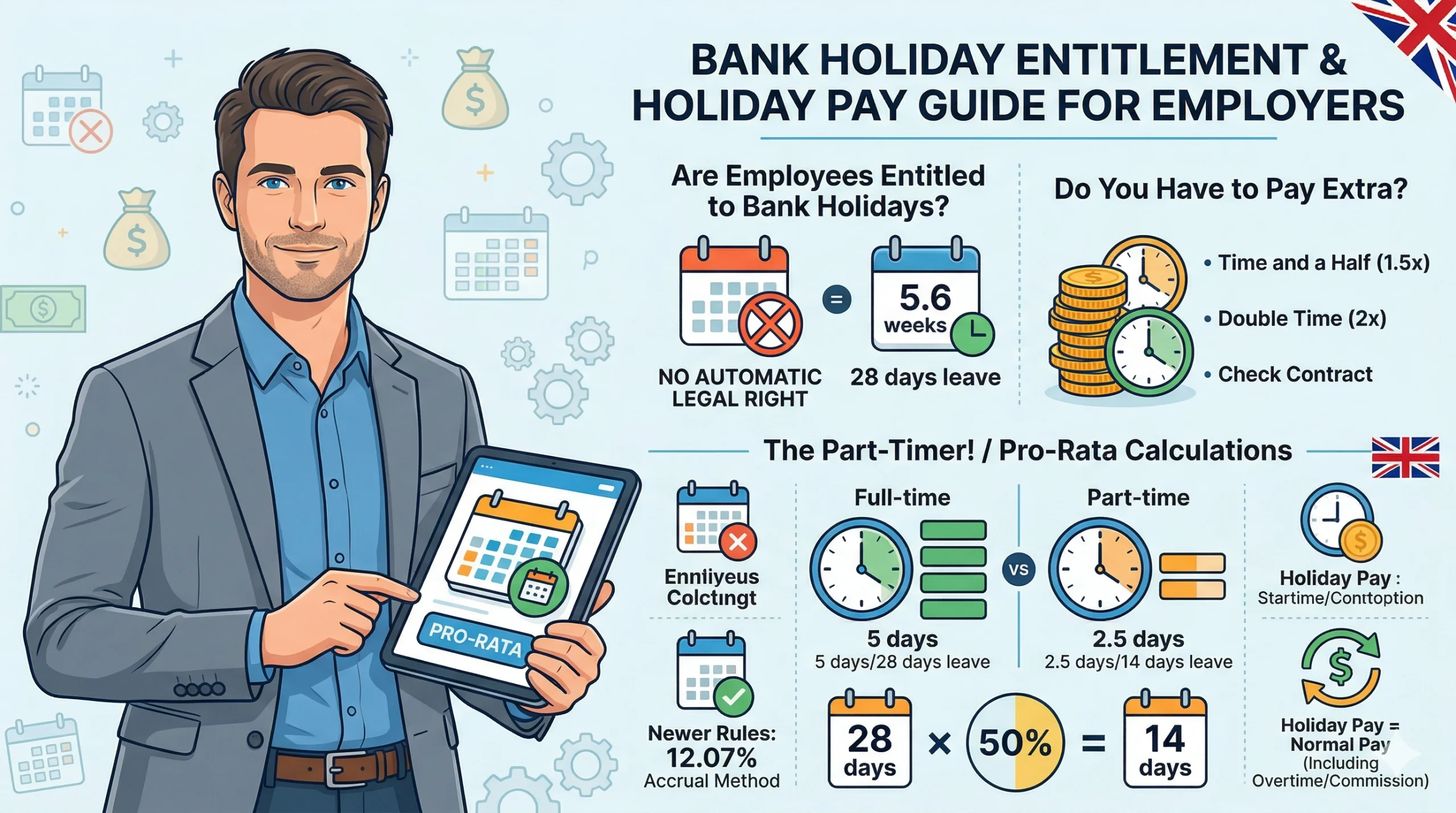
There is no automatic legal right for employees to have Bank Holidays off or to be paid extra for them.
What the law actually says is that full-time workers are entitled to 5.6 weeks of paid annual leave each year. For someone working five days a week, that’s 28 days.
As an employer, you can choose how Bank Holidays fit into that:
- You can include them within the 28 days, for example 20 days holiday plus 8 Bank Holidays
- Or you can offer them on top, which is more generous and often expected in some sectors
Where things go wrong is when this is not clearly explained. If your contracts are vague, employees will fill in the gaps themselves.
Do You Have to Pay Extra?
Another common assumption is that Bank Holidays mean higher pay. Legally, they do not.
You do not have to offer enhanced pay unless your contracts or policies say you do. That said, many businesses choose to offer it, especially where working Bank Holidays is expected.
What is “enhanced pay”?
Enhanced pay simply means paying more than an employee’s normal rate for working certain days, such as Bank Holidays.
Common examples include:
- Time and a half (1.5x normal hourly rate)
- Double time (2x normal hourly rate)
- An additional fixed bonus for working the day
For example, if an employee normally earns £12 per hour:
- Time and a half would be £18 per hour
- Double time would be £24 per hour
There is no legal requirement to offer this, but if you do state it in contracts or policies, you must apply it consistently.
If you don’t offer extra pay, be prepared for comparisons. Employees will often look at what others are getting elsewhere. It is not a legal issue, but it can quickly become a morale one.
The Part-Timer!
This is probably the biggest source of complaints.
If you simply give Bank Holidays off, part-time staff who do not work Mondays can miss out entirely. That can feel unfair and, in some cases, it is.
Part-time workers must not be treated less favourably than full-time staff, so the usual approach is to calculate holiday on a pro-rata basis.
What does pro-rata actually mean?
It just means adjusting entitlement in line with how much someone works.
A simple example:
- A full-time employee works 5 days per week and gets 28 days holiday (including Bank Holidays)
- A part-time employee working 50% of full-time hours (for example 2.5 days per week) would get 50% of that entitlement
So: 28 days × 50% = 14 days holiday per year (inclusive of Bank Holiday)
What does this mean in practice?
If a Bank Holiday falls on a day they normally work:
- They can either take it as paid leave using their entitlement, or
- Be required to work, depending on your policy
If a Bank Holiday falls on a day they do not normally work:
- They do not get an extra day off
- They do not get paid for that day
This is often where confusion arises. From the employee’s perspective, it can feel like they are missing out, when in reality their entitlement has already been adjusted.
Newer Rules You Should Know About
Statutory obligations have had a few updates over the last 12 – 18 months.
For irregular hours or part-year workers, you can now use a 12.07% accrual method to calculate holiday entitlement, which is particularly useful for casual staff, known as holiday pay.
Rolled-up holiday pay is also permitted again for certain workers, meaning holiday pay can be included in hourly rates, as long as it is clearly shown.
Another key point is how holiday pay is calculated. It should reflect normal pay, not just basic salary.
Why Might Holiday Pay Be Lower Than Normal Pay?
This is something employees regularly question.
In theory, holiday pay should reflect what someone normally earns. In practice, it can look lower for a few reasons:
- Only part of the leave entitlement must reflect full normal pay, with the rest sometimes paid at basic rate
- Overtime or commission may only be included if it is regular
- Holiday pay is often based on an average over previous weeks, so quieter periods reduce the figure
So while the calculation may be correct, it can still feel like a drop in pay from the employee’s perspective.
The Questions You’re Likely to Get
Most issues come down to fairness rather than strict legal rights.
Common questions include:
- Why don’t I get paid for Bank Holidays that fall on my non-working days?
- Why do full-time staff seem to benefit more?
- Why is my holiday pay lower than usual?
- Why did my previous employer pay extra for Bank Holidays?
Can I take a different day instead?
These are all reasonable questions, which is why clear communication is key and ensuring your contracts and employee handbook reflect your situation.
Keeping Things Simple and Fair
A few practical steps can make a big difference:
- Be clear in contracts about how Bank Holidays are treated
- Use pro-rata calculations for part-time staff
- Make sure holiday pay reflects normal earnings where required
- Explain your approach early so expectations are managed
Final Thoughts
Bank Holidays are one of those areas where the legal minimum and employee expectations do not always line up.
Handled well, they are straightforward. Handled poorly, they become a recurring source of frustration and indeed one that could be reviewed by the new Fair Work Agency.
A quick review of your policies now can save a lot of time later.