
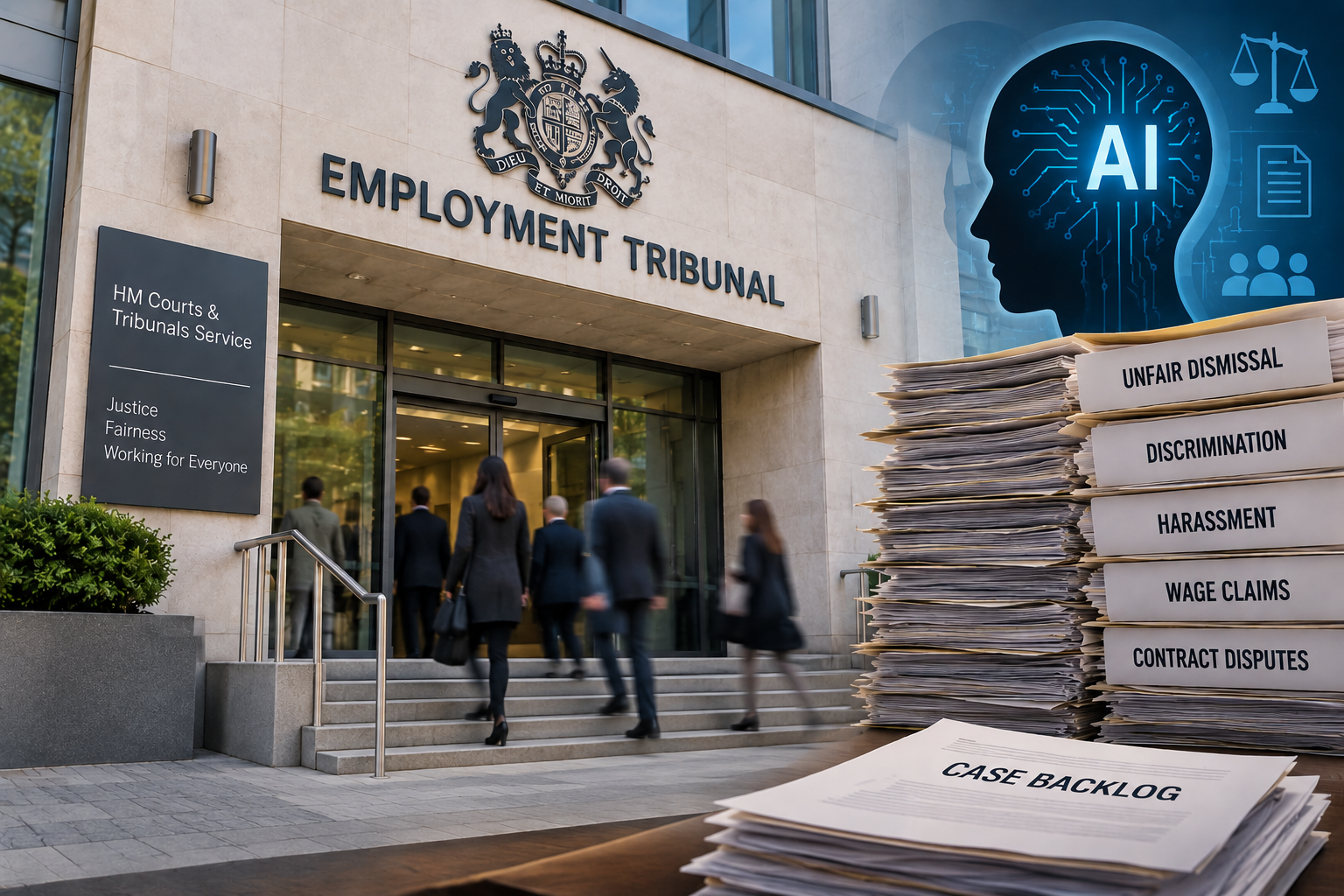
Employment tribunals are overwhelmed. Is AI making the problem worse?
Posted on September 15, 2026
The UK employment tribunal system is under growing pressure, creating uncertainty and cost for employers while delaying justice for employees with legitimate claims.
Recent Ministry of Justice figures show that between April and June 2026, employment tribunals received around 14,000 individual claims but resolved only 6,100. By the end of June, approximately 70,000 individual claims remained open, an increase of 51% compared with the same period a year earlier.
This is not a small administrative backlog. It means employers and employees may spend months, and sometimes considerably longer, waiting for disputes to be resolved. During that time, witnesses move on, memories fade, management time is consumed and legal costs continue to grow.
A recent Sunday Times article highlighted another factor adding to the pressure: the increasing use of artificial intelligence by employees and former employees to prepare their own tribunal claims.
AI is improving access to information. But when it is used without sufficient understanding of employment law or the factual context, it can turn a relatively straightforward workplace dispute into a long, complicated and sometimes legally confused claim.
What is happening to tribunal claims?
According to the Sunday Times, individual tribunal claims had risen sharply, while the unresolved caseload had also increased substantially. The article connected part of that growth and complexity to people using AI tools to create submissions without obtaining professional legal advice.
AI can produce a formal-looking document in seconds. It can suggest legal terminology, identify possible causes of action and structure a detailed account of what allegedly happened.
The difficulty is that the output can appear far more authoritative than it really is.
An employee may enter a relatively simple description of an unsuccessful probation, disciplinary warning, grievance or dismissal. The AI tool may then produce a lengthy document mentioning discrimination, whistleblowing, victimisation, breach of contract, human rights or constructive dismissal.
Some of those issues may genuinely be relevant. Others may have little or no connection to what occurred.
Because the document sounds legally sophisticated, the claimant may assume every point should be included. The result can be an embellished claim containing numerous allegations that the individual cannot properly explain, evidence or connect to the applicable legal tests.
This does not mean that employees using AI are necessarily being dishonest. In many cases, they may genuinely believe the output is accurate. The problem is that AI can supply legal language without ensuring that the user understands what it means or whether it fits the facts.
Tribunal judges have recognised the problem
This is more than anecdotal concern from employers.
In June 2026, the Presidents of the Employment Tribunals in England and Wales and Scotland issued formal guidance on applications for interim relief.
Interim relief is an emergency remedy available in certain dismissal cases. If granted, it can require an employer to reinstate or re-engage the employee, or continue paying them until the full case is decided.
Historically, tribunals across Great Britain received around 20 interim-relief applications a year. The guidance states that most regional offices are now receiving a similar number every month. It says the applications are often connected with alleged protected disclosures and frequently indicate the use of AI.
The tribunal presidents also highlighted the increasing amount of documentation accompanying these applications. Because interim-relief hearings must be arranged quickly, other hearings can be postponed to accommodate them. Yet the success rate remains low.
Their guidance identifies a particular problem with AI-generated legal submissions: they are often too long and complicated, include irrelevant material and fail to focus on the central issues.
That is a powerful warning. More information does not necessarily produce a stronger case.
AI does not understand the workplace context
Employment disputes are rarely resolved by identifying a legal phrase and attaching it to an event.
Context matters.
An employee may believe that a performance process started because they raised a concern. The employer may have emails, objectives and meeting notes showing that performance concerns existed months earlier.
An employee may describe a complaint as whistleblowing. However, a protected disclosure normally requires more than an allegation about their own treatment. The legal test includes whether qualifying information was disclosed and whether the employee reasonably believed it was in the public interest.
Similarly, an employee may believe that being treated differently amounts to discrimination. But a discrimination claim requires a connection to a protected characteristic or another specific protection under the Equality Act. Unfair or inconsistent treatment is not automatically unlawful discrimination.
AI cannot reliably establish these connections from a short, one-sided prompt. It does not interview witnesses, test competing accounts or understand everything that happened inside the organisation.
It may therefore reinforce the user’s interpretation instead of challenging it.
Why this matters to SMEs
Large employers may have internal legal teams and substantial budgets for litigation. Most SMEs do not.
Receiving a lengthy tribunal claim containing numerous allegations can be intimidating. Even where parts of the claim appear weak, the employer must still understand them, preserve relevant evidence and submit its response within the required time.
The cost is not limited to legal fees. Owners and managers can spend many hours reconstructing events, searching emails, preparing witness statements and attending hearings.
The latest official figures illustrate the scale of the wider problem. In April to June 2026, individual tribunal claim receipts increased by 28% compared with the same quarter a year earlier, while the number resolved fell by 6%. The open individual caseload reached its highest recorded level in the available series. Ministry of Justice tribunal statistics
Genuine claimants also lose when weak or unnecessarily complicated cases consume tribunal capacity. Cases involving serious discrimination, whistleblowing or unfair dismissal may take longer to reach a hearing.
What should SME employers do?
The answer is not to assume every employee complaint is AI-generated or to dismiss a claim because its language appears exaggerated. That could cause the employer to overlook a genuine legal risk.
Instead, SMEs should concentrate on good process and reliable evidence.
Managers should document performance and conduct concerns when they arise, rather than reconstructing events after a claim has been made. Important decisions should be supported by clear reasons, relevant evidence and records of the process followed.
When an employee raises a grievance or concern, the employer should identify the underlying factual allegations. A 20-page document may contain only three or four issues that require investigation.
Employers should also avoid answering an excessive complaint with an equally excessive response. The objective is to establish what happened, which evidence is relevant and whether the organisation acted reasonably and lawfully.
Most importantly, seek advice early. A short conversation before suspending, disciplining or dismissing someone can prevent a procedural mistake that later gives an AI tool something significant to build upon.
AI needs judgement and guardrails
AI can improve access to employment information and help people organise their thoughts. Used properly, it can help both employers and employees ask better questions.
But it should not be treated as a substitute for professional judgement.
The current tribunal backlog shows what can happen when producing a claim becomes easier but assessing its relevance remains difficult. AI can generate more allegations and more pages, but it cannot make weak evidence stronger or remove the need to understand the legal and workplace context.
For SMEs, the best protection remains straightforward: act fairly, follow a reasonable process, maintain good records and take advice before a manageable workplace issue becomes a tribunal claim.
Free 30-minute People Risk Triage
In 30 minutes we can sanity-check what’s most relevant from the Act for your business and identify your top priority actions.
Feel free to give us a call below, or book directly using the link.
https://calendly.com/jo-ferguson/30min
- +44 (0) 2382 518 004
- jo@smehrconsultancy.com
- www.smehrconsultancy.com